Whenever
I think of an organization I am reminded of “Symphony”. In a symphony there are
several singers singing and several musicians playing different kinds of
instruments to produce desired music.
You would all agree that the
success of the symphony lies not in
individual brilliance of any single musician but in the combined effect that their playing
together leads to . It lies in the understanding of the Composer to use which
instrument , which note, which musician to “play what” and “play when” to produce the magic of music, the
success lies in the co-ordinated efforts of 100s of individual musicians
playing individually but in a co-ordinated unison.
The difference between music and noise is because of the fine art
of coordinated actions of these
individual fine musicians . If each of these musicians were to play what they
wished and when they wished to, all it
would create is noise even if you had all the
star musicians performing
together .
An
organization is one such Symphony , one such well oiled machine where the
success of the organization depends on the efforts of various departments and various individuals working towards a preconceived objective . The better the Top
Management ( Composer ) understands the interplay between various elements like
Objective, operations , Strategy , Processes , HR , Sales , Finance , Marketing, Competencies
etc and the better they are able to align all these elements , the better the
organization will perform . Some
thinkers like Mckinsey created a framework called the 7 S framework to understand and depict this interplay.
It is quite evident from the
model that we are talking about
aligning the 7s’s and fine tuning them to produce the desired results and the
custodian of as many as 3 S’s ( structure , Staff & skills) is the HR function .
I guess keeping this in view of and the fact that Human Resource is one of the
major resources required for a business to succeed apart from the Financial and
other resources , Dave Ulrich popularised the Concept of HR Business partner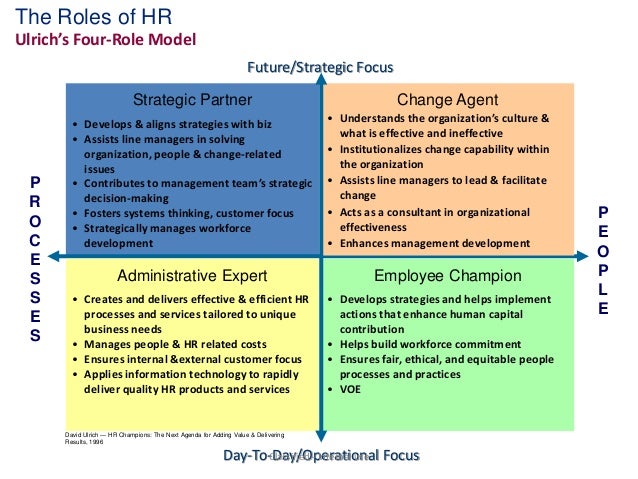
The Idea was that as we
move from ‘day to day’ focus on ‘ Processes and People’ to” future /
Strategic” focus on “Processes and People’ the role of HR will also need to
evolve from “Admin and Employee championing”
to “Change agent and Strategic
Partner “. What it meant is that organizations actually need active participation of HR
function as much as of any other function like
Sales & Marketing , Operations and /or Finance in setting the blue
Print / direction of the Company . It
will not auger well for an organization if the HR is seen only as a service
Function .
Typically , a business usually writes a business plan where
it envisages the revenue and the costs based on its understanding of the
Industry , the Business, the markets, its specific strategy , its target
customers , it various Processes etc .
The biggest variable in the business Plan is the effort envisaged ( read structure, staff , sales &
Marketing effort etc ) and the result envisaged ( read revenue, Objective etc )
. In my own experience of more than two decades of working with several
organizations , I find the inability to model the correct structure , correct
people , correct effort to get the desired results, as the single largest cause .which leads to
underperformance and / or failure.
Hence the strong need for a HR to act as a business partner . While the need
has got established , I still find gaping holes in many cases in the use of HR
function both from a Top Management structure perspective ( read what does the
Top management think of the role of HR ) and from the practitioners own
Competence perspective ( what all does the practitioner need to know to be able
to contribute as an Business partner ) . In most cases the Practitioners
unknowingly are stuck in the mindset of an administrator or at most of an “
Employee Champion “ ( keeping in mind
the needs of the employees to keep them motivated , engaged etc ) or that of a
“change agent” ( read helping organization to change through trainings ,
organization development etc ) .
Mindset of a strategic HR business partner is to think about
how the interplay of HR , the structure , the people etc. can help in the organization achieving its “Shared
Objective” . Mindset is that can I bring differentiation in the Organization
and its deliverable products / services by organizing , aligning , hiring and
structuring the Human Resource of the organization to improve Top line , Positioning
, EBIDTA , PAT etc .
This is not an easy task and it is then no more just a
fashionable statement to make “HR as
Business partner “. It is a huge responsibility and the success and failure of
the organization, then depends as much on the decisions of HR ,as it depends on
any other function, if not more .
My feeling is that the gap in expectation from HR to act is
a business Partner to what it actually does, is that our training in HR is still stuck
in the past era . Maybe the HR
Professional are also themselves to blame since their assumption about their
own role has to evolve further .
The critical elements for all young HR practitioners to
focus on in case they wish to be seen as serious contenders for Business
Partner role are as follows ;
1. Clear
understanding of the industry that they operate in , its macro/ micro parameters, the external environment , etc
2. Clear
understanding of the business that they
operate including its customers , its USP , it operational aspects, it’s
marketing / Sales dynamics, etc
3. Clear
understanding of all financial aspects
of the concerned business. Knowing various financial ratios / parameters .
4. Clear
view on how the interplay of structure , Staff, Competencies etc can have an
impact on the Business, its USPs , its products/ services, its services,
Quality etc .
The journey of HR as a service function to that of becoming
a business Partner is thus dependent on the ability of HR professional to understand all business dynamics and the
ability to influence the outcomes of an organization by the interplay of
various HR elements to create unique / profitable and sustainable businesses .

_Page_01.jpg)
_Page_02.jpg)
_Page_03.jpg)
_Page_04.jpg)
_Page_05.jpg)
_Page_06.jpg)
_Page_07.jpg)
_Page_08.jpg)
_Page_09.jpg)
_Page_10.jpg)
_Page_11.jpg)